

Revival in History: Introduction
December 20, 2020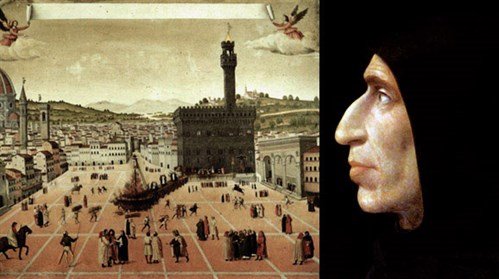
A Monk’s Revival – Gironalo Savonarola
When revival came to Florence, Italy, in 1496-98, God’s human instrument was the Italian Roman Catholic monk Savoranola.
Girolamo Savonarola was born at Ferrara, the son of Niccolò Savonarola and of Elena Bonaccorsi. He was educated by his paternal grandfather, Michele, a celebrated doctor and a man of rigid moral and religious principles. From this elderly scholar, whose own education was of the 14th century, Savonarola may have received certain medieval influences. In his early poetry and other adolescent writings the main characteristics of the future reformer are seen. Even at that early date, as he wrote in a letter to his father, he could not suffer “the blind wickedness of the peoples of Italy.” He found unbearable the humanistic paganism that corrupted manners, art, poetry, and religion itself. He saw as the cause of this spreading corruption a clergy vicious even in the highest levels of the church hierarchy.
When Savoranola revival began, he was shocked by the vice and immorality of the world around him in Italy and by the corruption he knew existed in the Roman Catholic Church. As a youth he would walk beside the River Po, singing to God and weeping for the sins, the injustices, and the poverty of the people about him. He wept and grieved over the lewdness, luxury, and cruelty of many leaders of the church. He would lie for hours prostrate on the altar steps in the church, weeping and praying about the sins of the age and the sins of the church.
At the age of twenty-two, Savonarola wrote a paper, “Contempt of the World,” in which he likened the sins of the current age to those of Sodom and Gomorrah. He slipped away without first telling his family and entered a monastery to begin a life of fasting and prayer. He was desperate to see God send revival. For years Savonarola studied Scripture, waited for God, and prayed. Suddenly one day God gave him a vision: the heavens opened and a voice commanded him to announce the future calamities of the church to the people. Filled with a new powerful anointing of the Holy Spirit, Savonarola began to preach to the people. When the Spirit of God came upon him, the voice of Savonarola thundered as he denounced the sins of the people. Revival power gripped the whole area. Savonarola’s audience—men and women, poets and philosophers, craftsmen and laborers—all sobbed and wept. People walked the streets so gripped by conviction from the Holy Spirit that they were half-dazed and speechless. On several occasions while seated in the pulpit, all in the church could see Savonarola’s face seemingly illuminated with a heavenly glow, and he would sit in the pulpit lost in prayer or in a trance for up to five hours at a time. The smaller churches could not hold the crowds that came to hear him, so for eight years Savonarola preached in the large cathedral in Florence, Italy. People came in the middle of the night, waiting for the cathedral doors to open so they could hear his message. Savonarola prophesied he would be with them only eight years.
The Spirit of the Lord was upon Savonarola. He prophesied that the city ruler, the pope, and the king of Naples would all die within a year, and so they did. For months he predicted that God would punish Florence with an invasion from across the Alps. King Charles VIII of France and his army crossed the Alps and pre- pared to attack. Savonarola went out alone to meet them. He faced the French army single-handed and twice persuaded Charles to turn back and not attack Flo- rence. The wicked city government was overthrown, and Savonarola taught the peo- ple to set up a democratic form of government. The revival brought tremendous moral change. The people stopped reading vile and worldly books. Merchants made restitution to the people for the excessive profits they had been making. Hoodlums and street urchins stopped singing sinful songs and began to sing hymns in the streets. Carnivals were forbidden and forsaken. Huge bonfires were made of worldly books and obscene pictures, masks, and wigs. Children marched from house to house in procession singing hymns and calling everyone to repent and empty their house of every “vanity.” A great octagonal pyramid of worldly objects was erected in the public square in Florence. It towered in seven stages sixty feet high and 240 feet in circum- ference. While bells tolled, the people sang hymns and the fire burned, reminiscent of Paul’s revival bonfire in Ephesus centuries before (Acts 19:18-20).
On 12 May 1497, Pope Alexander VI excommunicated Savonarola and threatened the Florentines with an interdict if they persisted in harboring him. After describing the Church as a whore, Savonarola was excommunicated for heresy and sedition. Savonarola feared neither men nor demons. He exposed sin wherever he found it. He was a pioneer of the Protestant Reformation, though he was a loyal Roman Catholic even when the pope excommunicated him. Savonarola replied from his pulpit that we must obey God rather than man. He said the pope was a fallible person like every other sinner and could make mistakes and sin just as any other person.
On 18 March 1498, after much debate and steady pressure from a worried government, Savonarola withdrew from public preaching. Under the stress of excommunication, he composed his spiritual masterpiece, the Triumph of the Cross, a celebration of the victory of the Cross over sin and death and an exploration of what it means to be a Christian. This he summed up in the theological virtue of caritas, or love. In loving their neighbors, Christians return the love which they have received from their Creator and Savior.
The corrupt pope, the cardinals, and the priests were outraged. In time, the political and religious enemies incited a rough mob against Savonarola. They battered down the doors of the sanctuary of the convent where he was staying and captured him. Savonarola was severely tortured as his enemies tried to get him to confess to heresy. His hands were bound behind him. He was hoisted to a great height and then dropped almost to the ground when the rope snapped him up again, pulling his shoulders out of joint and tearing his muscles. Burning coals were put to his feet to try to get him to recant. He refused. This was repeated several times. Re- turning to his cell, Savonarola would kneel and ask God to forgive the people.
In his prison cell in the tower of the government palace he composed meditations on Psalms 51 and 31. On the morning of 23 May 1498, the three friars were led out into the main square where, before a tribunal of high clerics and government officials, they were condemned as heretics and schematics, and sentenced to die forthwith. Stripped of their Dominican garments in ritual degradation, they mounted the scaffold in their thin white shirts. Each on a separate gallows, they were hanged, while fires were ignited below them to consume their bodies. To prevent devotees from searching for relics, their ashes were carted away and scattered in the Arno.
One man is enough for God.
One lone man, totally surrendered to God, burning with passion for revival in the church and nation and the salvation of the people, had for several years turned the tide against evil in church, government, and the lives of the people. If God could use one Savonarola to bring such a mighty revival at such an impossible time, what could He not do in answer to a movement of truly prevailing prayer by the thousands of believers and Christian leaders who love Christ today? But will we prepare the way of the Lord through prayer like Savonarola did? Will we feed on God’s Word and memorize much of the Bible by heart as he did? Will we spend the nights and hours in prayer and fasting as he did?
Savonarola religious ideas found a reception elsewhere. In Germany and Switzerland the early Protestant reformers, most notably Martin Luther himself, read some of the friar’s writings and praised him as a martyr and forerunner whose ideas on faith and grace anticipated Luther’s own doctrine of justification by faith alone. In France many of his works were translated and published and Savonarola came to be regarded as a precursor of evangelical, or Huguenot, reform. Within the Dominican Order Savonarola was repackaged as an innocuous, purely devotional figure (“the evolving image of a Counter-Reformation saintly prelate, and in this benevolent and unthreatening guise his memory lived on. Philip Neri, founder of the Oratorians, a Florentine who had been educated by the San Marco Dominicans, also defended Savonarola’s memory.
Ezekiel 22:30 So I sought for a man among them who would make a wall, and stand in the gap before Me on behalf of the land, that I should not destroy it; but I found no one.
If the Story of Savoranola inspires you would you take a moment and pray that God will use you mightily for your generation.
Reference: Revival Fire by Wesley Duewel.


